
Native or Hybrid mobile application: a tailor-made solution for your digital growth
Choosing between a native or hybrid mobile application is a key decision to balance performance, user experience, and scalability.
A Hybrid app developement company, we design and develop custom native and hybrid mobile applications aligned with your business objectives and your users’ expectations.
Our goal is to reduce time-to-market, optimize development costs, and deliver a reliable, maintainable, and scalable application.
Our Expertise in Hybrid App Development Frameworks
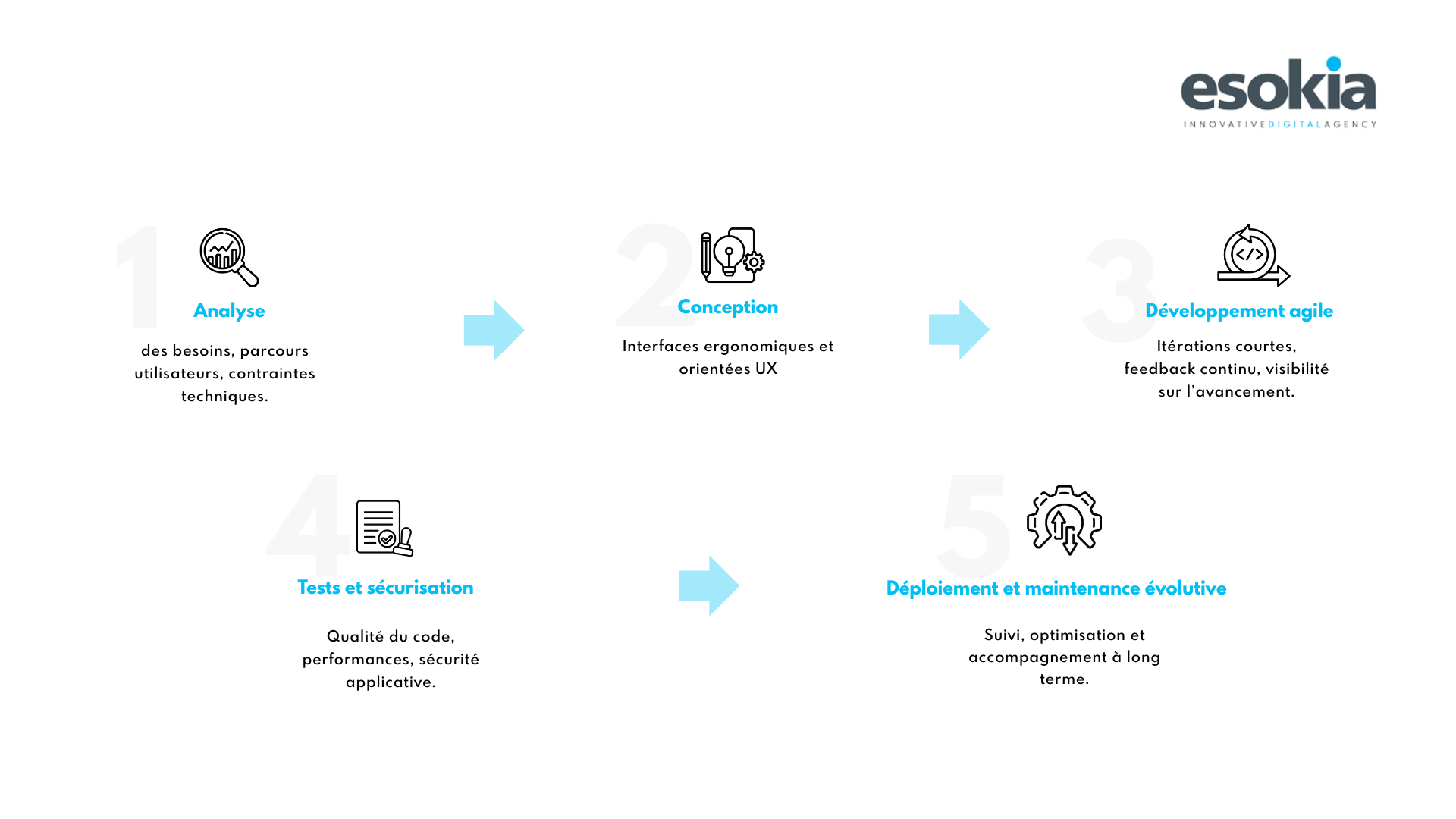
We support our clients throughout the entire mobile application lifecycle, from initial scoping to production release and ongoing evolutionary maintenance.
Our teams work with several hybrid app development frameworks, known for their robustness and advanced features:
- React Native: ideal for JavaScript ecosystems and projects requiring strong interoperability with the web
- Flutter: renowned for near-native performance and consistent UI across all platforms
We select the most suitable framework based on your business, technical, and budgetary constraints — not the other way around.
Why choose React Native or Flutter for hybrid app development?
- Optimized cross-platform development: a single codebase for both iOS and Android
- Near-native performance: smooth navigation, responsiveness, and access to native features
- Controlled costs and timelines: faster time-to-market with optimized budgets
- Scalable and future-proof applications: architectures designed to grow with your business needs
Esokia is proof that the intervention of experienced external developers makes it possible to:
Use hybrid application development, for example, to concretize an idea in the form of a prototype that will be tested, without investing large sums. It is much faster to set up than for a native application. The list of benefits doesn't end there! Hybrid applications have also built their popularity through:
Easier scaling on another platform
Because hybrid applications require a single code base, they can be deployed across multiple devices. Concretely, a hybrid application created for Android can also be used on iOS.
Low development cost
Hybrid application development is known to be much cheaper than that of a native application, both in terms of upfront costs and those related to application maintenance. Indeed, with a single code base, the hybrid app requires less development time and fewer developers than, for example, the native app.
Offline availability
Due to its native infrastructure, the hybrid mobile app works offline. An efficiency gain particularly appreciated by users, who do not need to connect to the internet from their mobile device to access the information they need!
React Native or Flutter: Which framework should you choose?
We help you make an informed decision based on concrete criteria.
React Native
- Seamless integration with existing web backends
- Large JavaScript ecosystem
- Excellent compatibility with React-based projects
Flutter
- Outstanding UI performance
- Consistent graphical rendering
High stability for complex or highly visual applications
Entrust your mobile application to hybrid development experts
At Esokia, a trusted Hybrid app developement company, we build robust, high-performance React Native and Flutter applications designed to last. From design to production, our teams support you with a pragmatic, results-driven approach focused on quality and reliability.
Let’s discuss your project and turn your idea into a scalable, reliable mobile application aligned with your business goals.
FAQ – Hybrid and native mobile app Ddvelopment
Popular Questions
A native mobile application is developed specifically for a single platform (iOS or Android) using platform-specific languages. A hybrid application uses a shared codebase that runs on multiple platforms. A Hybrid app developement company helps you choose the best approach based on performance needs, budget, and time-to-market.
Hybrid applications are ideal when you want to launch quickly on both iOS and Android, reduce development costs, and maintain a single codebase. They are well suited for business apps, MVPs, and scalable digital products.
Modern frameworks like React Native and Flutter offer near-native performance. In most business use cases, users cannot tell the difference. A skilled Hybrid app developement company ensures optimal architecture and performance tuning.
Both frameworks are excellent choices. React Native is ideal if your ecosystem is JavaScript-based or already uses React. Flutter excels in UI performance and visual consistency. The right choice depends on your technical context and long-term goals.
Yes. Hybrid apps can access device features such as camera, GPS, biometric authentication, push notifications, and sensors through native APIs and plugins.
Absolutely. Hybrid applications are designed to be scalable and maintainable. With the right architecture, they can evolve alongside your business needs, add new features, and integrate with complex systems.
Development time depends on the app’s complexity, features, and integrations. On average, hybrid development is faster than native development thanks to a shared codebase and streamlined workflows.
As a Hybrid app developement company, we analyze your business objectives, technical constraints, user expectations, and budget to select the most suitable framework and architecture.
Yes. We offer ongoing maintenance, updates, performance optimization, and feature evolution to ensure your application remains secure, stable, and up to date.
Yes. We assist with migration from native or legacy technologies to modern hybrid frameworks while minimizing risks and ensuring business continuity.